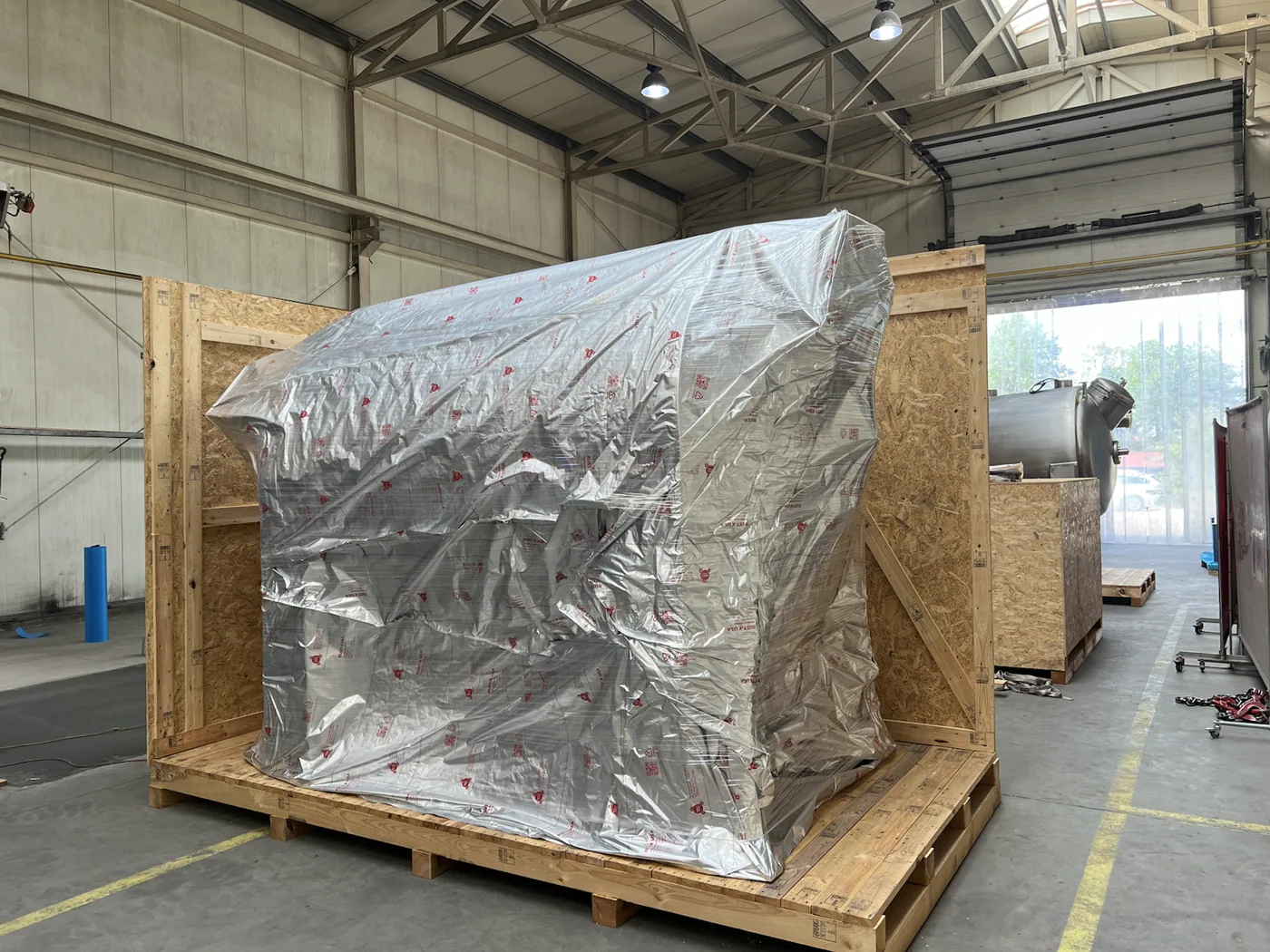
Salt
The air on a sea route carries salt. Shrink wrap heat-shrunk onto the item seals it tightly, so salt does not reach the surface of the cargo.

Export and sea freight
We prepare machinery and cargo for sea freight and export. We pack anywhere in Poland, under cover, almost always in the customer's hall (approx. 98% of jobs). Shrink wrap protects the cargo from water, salt and dirt from the outside. For a long voyage in a container, it is combined with protection against moisture from the inside.
In the photo: industrial items wrapped in shrink wrap before leaving the hall.
Conditions en route
The air on a sea route carries salt. Shrink wrap heat-shrunk onto the item seals it tightly, so salt does not reach the surface of the cargo.
The film keeps out water from outside: rain, spray and water on the handling yard. However, it does not remove moisture that stays under it or in the container. That is why protection from the inside is added for a long voyage (see below).
Once heat-shrunk, the film does not flap in the wind and does not collect water like a tarpaulin. It takes the shape of the item, including around irregular edges. This matters especially for cargo on an open platform, which has no container roof above it.
Terms
Export and sea freight packing means preparing cargo for the stresses of a specific route: long transit time, temperature changes, moisture, salt and transhipment. No regulation defines it, and there is no single mandatory standard.
The closest thing to a common reference is the CTU Code, the rules for packing containers and other cargo transport units drawn up by the IMO, ILO and UNECE in 2014. The IMO calls it a non-mandatory code of practice. It does not replace regulations, but it shows what forces and what moisture act on cargo in transit. The binding rules are specific regulations, e.g. for wood (ISPM 15), for dangerous goods (IMDG) and for container mass (VGM).
Machinery
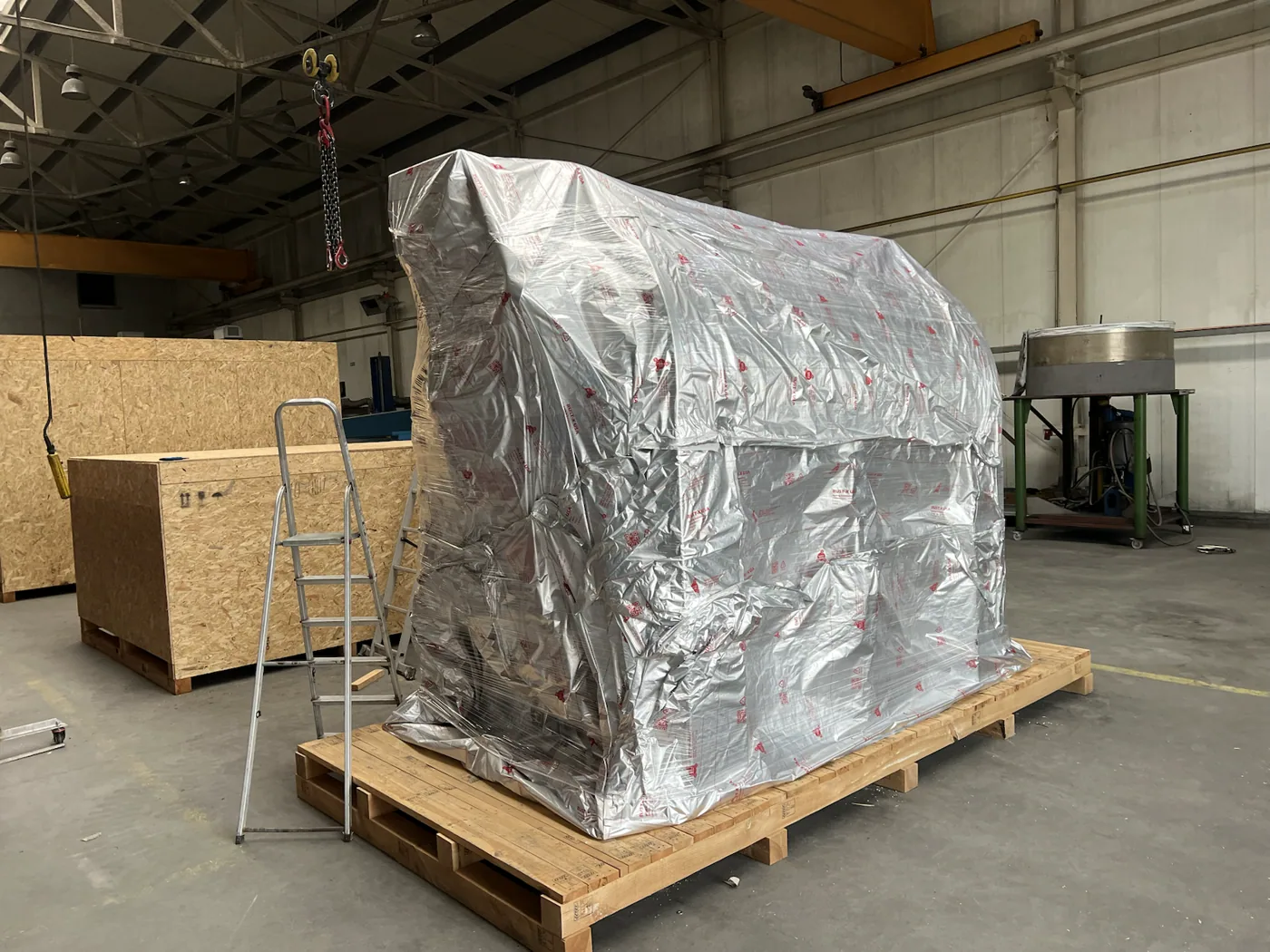
A machine for sea freight is packed in several layers: securing it to a base, protecting the metal against corrosion, an outer cover and marking. GDV recommends bolting the machine to the base or the bottom of the packaging and leaving at least 30 mm of clearance from the packaging walls, and at least 50 mm for sensitive parts.
For metal, GDV describes three methods of temporary corrosion protection: a coating (oil, wax), a desiccant in tightly heat-sealed barrier foil, or VCI. In this set-up, shrink wrap is the outer cover. It seals the machine against water, salt and dirt, takes its shape and needs no structure built around it. We show how we pack machinery on the machine packing page. We explain the difference between VCI film and barrier foil in the article VCI film or barrier foil (in Polish).
The opakuj shop sells materials for internal protection: aluminium barrier foil with VCI, VCI anti-corrosion paper and desiccant.
Condensation
Shrink wrap protects against water from outside, but on its own it does not protect against condensation in a container. According to the CTU Code, moisture in a closed container comes mainly from the cargo itself, and also from wooden dunnage, pallets and packaging. Even dry wood (12–15% moisture content) brings the relative humidity in the container to around 60–75%, while the risk of steel corrosion rises from as low as 40%. That is why the Code recommends drying dunnage and packaging, or using desiccants together with sealed plastic packaging.


Here the recommendations differ: companies that make shrink wrap covers (e.g. for boats) recommend ventilating them, while the CTU Code and GDV describe the opposite approach, i.e. a sealed, heat-sealed barrier with a desiccant inside. Both approaches make sense, but not together, because a desiccant under ventilated film quickly becomes saturated when fresh air keeps flowing in.
So before packing, check the route and voyage time, then choose one solution: shrink wrap as an outer cover with VCI, or a sealed barrier with a desiccant.
Securing in a container
In a container, cargo is secured primarily by blocking, i.e. pushing it up against the walls or filling the gaps with timber beams, empty pallets or airbags. The CTU Code recommends that the sum of horizontal gaps should not exceed 15 cm. The weight of the cargo alone is not enough, even with high friction, because vibration can shift it. When the cargo cannot be blocked, lashings are needed.
Forces at sea depend on the sea area. The CTU Code assumes a transverse acceleration of 0.5 g for the Baltic Sea and 0.8 g for unrestricted ocean shipping. The lower lashing points in a standard container are rated at least 10 kN, so a heavy machine cannot be held by straps to the floor anchors alone.

Under the CTU Code, the “packer”, i.e. whoever loads the container, is responsible for stowing and securing the cargo in it. This may be the shipper. That is why, before shipping, agree in writing who packs the machine, who loads and secures it in the container, and who declares the container mass.
Wood in packaging

The IPPC mark means that the wooden packaging has been treated in line with the international standard ISPM 15, most often by heat treatment (HT): at least 56°C for at least 30 minutes throughout the whole cross-section of the wood. The mark has four parts: the IPPC symbol, the country code (PL in Poland), the number of the facility applying the mark and the treatment code (e.g. HT). The standard covers solid wood packaging: crates, pallets, skids, wedges and dunnage. It does not cover wood up to 6 mm thick or glued and pressed materials such as plywood, particleboard, OSB or veneer.
For exports outside the EU, the requirements depend on the importing country. PIORiN recommends ISPM 15-compliant packaging for every export to third countries, because the vast majority of countries require it. Within the EU there is, as a rule, no such requirement. If the wood does not bear the required mark, the importing country may detain the consignment, remove the packaging, treat it, destroy it or send it back.
Shrink wrap is not wood, so ISPM 15 does not apply to it. The mark concerns the wood that travels with the cargo: pallets, skids and wedges in the container.
We do not issue the container packing certificate under the IMDG Code, which is required for dangerous goods. After each job, we draw up a handover report with the customer, signed by both parties: what we packed, when and, for example, how many containers with which numbers. This confirms the service performed; it is not a certificate.
In sea transport, the carrier is usually not liable for damage caused by poor packaging. The Polish Maritime Code (Art. 165 § 2) exempts the carrier, among other things, from damage resulting from “insufficiency of packing” and from an act or omission of the shipper, so good packaging is largely the sender's responsibility. We describe how obligations are divided between the sender, the carrier and the driver on the way to the port in the article who is responsible for securing cargo (in Polish).
Sea and air
Packing for air and sea freight differs mainly in what it has to protect against. At sea, the biggest risks are water and a long time in transit. According to data from the insurer TT Club for 2020, sea transport accounted for 65% of reported water damage claims, road for 14%, air for 7% and warehousing for 13%. TT Club attributes this to the length of the journey and the climate zones the cargo passes through.
On an aircraft, cargo spends less time in transit, and the weight and volume of the packaging are what count. However, the requirements for wood (ISPM 15) apply to wooden packaging in international trade regardless of how the cargo travels.
Coverage
We deliver our materials to:
Depending on the order specification or the details of the job, we can deliver our goods and services throughout Europe. If your country is not on the list, contact us. We pack the cargo itself at the customer's site: we come with film and equipment to customers anywhere in Poland.
How we work
The more of these five things you give us straight away, the sooner we will come back to you with a quote and an arrival date.
Before you book a truck to the port, agree who loads the cargo and who secures it. We describe the regulations in the article on securing cargo (in Polish).
Scope
We pack cargo in shrink wrap at the customer's site. There are a few things that come up in sea shipping that we do not do, and it is better to say so up front:
| Task | Who |
|---|---|
| Packing the cargo in shrink wrap | Opakuj.com, at the customer's site, under cover |
| Stowing and securing the cargo in the container | the packer under the CTU Code (may be the sender) |
| Verified gross mass of the container (VGM) | the shipper |
| Container packing certificate (dangerous goods only) | the packer, under the IMDG Code |
| Transport and securing on the ship | the carrier and the shipowner |
On video
More:
The video loads from YouTube only after you click it. All videos: Opakuj.com channel on YouTube.
Frequently asked questions
We deliver our materials and services to Germany, the Czech Republic, the Netherlands, Belgium, France and Lithuania. Depending on the order specification, we can deliver them throughout Europe. If a country is not on the list, please contact us.
Shrink wrap protects cargo from water, salt and dirt from the outside. Once heat-shrunk, it takes the shape of the item and seals it tightly, including around irregular edges. On its own it does not protect against moisture that condenses in the container, so for a long voyage it is combined with VCI or a sealed barrier with a desiccant.
Yes. We have no size limit: we fit the film to the item on site. We also pack cargo that standard packaging cannot cover: tanks, silos and oversized components.
The dimensions of the item (length, width, height), its location and the planned transport date. Photos of the cargo help: you can attach them as a link in the form on the home page. On this basis we choose the film, equipment and arrival date.
No. The ISPM 15 standard does not cover glued and pressed materials such as plywood, particleboard, OSB or veneer, nor wood up to 6 mm thick. The mark is required on solid wood: pallets, skids, wedges and beams.
Yes, a handover report signed by both parties: what we packed, when and, for example, how many containers with which numbers. It is not the IMDG Code container packing certificate, which applies to dangerous goods.
Give us the cargo dimensions, location, loading date and destination country, and we will prepare a quote. You can also call: +48 605 525 882.
Other services
Sources: IMO, CTU Code; PIORiN, “Opakowania drewniane” (Wooden packaging, ISPM 15); TIS-GDV, “Machinery, machine parts”; TT Club, “Protecting cargo from wet damage” (05.10.2021). Without a link: Polish Maritime Code (Art. 165), ISPM 15 (IPPC), IMDG Code 5.4.2 (according to guidance from the UK MCA). This page describes general principles and the scope of the service; it is not a substitute for legal advice.